Perception Without Conception: The Two Selves and Zen’s Absolute

Daniel Kahneman and Jason Riis once suggested that we do not live as a single self, but as two. One is the remembering self, the inner narrator that looks backward, gathering scattered moments into the story of “my life.” The other is the experiencing self, which does not tell stories at all but simply lives each moment as it unfolds—raw, immediate, without commentary.

At first glance, this distinction may seem like a neat psychological model. But when held beside Zen Buddhism’s ancient teaching of the relative and the absolute, something more profound comes into view. The relative is the world refracted through concepts: roles, judgments, categories, identities. The absolute is life itself, before it is parceled out and named. As Yamada Ryōun, former Abbot of the Sanbō-Kyōdan lineage, expressed: “the self and the whole universe are originally one being” (1).

The resemblance is not superficial. The remembering self is the relative, living in stories and concepts. The experiencing self is the absolute, life before words. What psychology and Zen seem to have discovered in parallel is a single truth: reality is lived twice—once directly, once through the lens of conception.

Two Selves, Two Ways of Reality

Kahneman’s research showed that these two selves not only differ, but sometimes contradict. A person may remember a vacation as blissful because it ended well, though most of the time was stressful (2). The story rewrites the life that was actually lived.

Zen speaks similarly. The relative is not false—it is essential for planning, for communication, for navigating culture. But it is partial. It carves life into pieces and mistakes those fragments for the whole. The absolute is the same life, but seen before division: the river flowing before we call it water.

The Diamond Sutra counsels us to “abide nowhere” (3). Even the idea of “self,” even the word “truth,” becomes a distortion if clung to. What remains is what Kahneman would call the experiencing self: the pulse of life before narration.

The Remembering Self and the Relative

The remembering self is useful, even indispensable. It gives continuity and identity, allowing individuals and cultures to persist. Yet it is selective. It edits, chisels, and reshapes. In Zen language, it is the relative self: necessary for survival, but clouded by illusion when mistaken for the real.

Yamada warned that when this true self is not directly discovered, people project it outward—onto gods, doctrines, or transcendent ideas (1). Psychology would say that the remembering self is forever creating stories, even about that which cannot be narrated. Its mistake is not in telling the story, but in mistaking the story for reality itself.

The Experiencing Self and the Absolute

The experiencing self does not narrate. It does not stand back to judge or compare. It simply lives. Kahneman’s data revealed how much this perspective diverges from memory: moment-to-moment reports often tell a different story from what is recalled later (2).

Zen names this the absolute: life before conceptual partition. Yamada expressed it as nonduality: “the self and the whole universe are originally one being” (1). In such vision there is no “other,” no division to defend, no distance to close. It is intimacy itself.

Steven Pashko’s novel The Hero’s Gift: A Journey to the Inconceivable offers a literary mirror of this. When the characters put on their special glasses, the ordinary overlay of concepts dissolves. A tree is no longer “tree”; a face no longer “friend” or “stranger.” Nothing has changed, yet everything has—things are no longer mediated by words but revealed in their immediacy (4). This is perception without conception: the absolute glimpsed in fiction, echoing the experiencing self in psychology.

Why Two Selves at All?

If the absolute and the experiencing self are so primary, why does humanity live so deeply entangled in the relative and the remembering self? Neuroscience offers one clue. Michael Gazzaniga’s work revealed that only one hemisphere of the brain specializes in language and concepts (5). The remembering self may emerge from these linguistic structures, while the experiencing self reflects a more fundamental, bilateral form of perception. In this sense, the remembering self is not original but layered atop a deeper ground.

Zen would agree. The relative is derivative; the absolute precedes it. The trouble comes when the derivative masquerades as the whole.

Shifting Between Selves

Meditation is the ancient art of redressing this imbalance. Techniques such as just sitting, breath counting, or body scanning invite the practitioner to remain indifferent to thoughts and concepts, letting them drift by without reinforcement. Psychology might call this extinction: persistent non-attention weakens the dominance of concepts. Over time, thought loosens its grip, and perception clears into the simplicity of the absolute.

This toggling also clarifies puzzles such as the placebo effect. Placebos relieve suffering, though they contain no active agent. One possibility is that attention shifts, however briefly, from the remembering self’s story—“I am ill”—to the experiencing self’s direct perception, where symptoms are not framed as “mine” (6). When the story loosens, the suffering loosens. In The Hero’s Gift, this is dramatized through the toggling of vision: with the glasses on, the world is whole; without them, the conceptual overlay descends again (4).

Practical Implications

If the remembering self and the relative mirror one another, and the experiencing self and the absolute likewise, then this understanding reshapes more than philosophy.

  • Well-being. To measure life only through the remembering self is to mis-measure it. The experiencing self lives the texture of reality that memory cannot preserve. Both accounts must be honored.
  • Ethics. From the absolute’s perspective, wholeness shines. In nonduality there is no “other” to harm. Ethical behavior arises as naturally as breath: generosity, compassion, and restraint are not duties, but inevitabilities. No one willingly harms their own hand; in nonduality, no one is separate enough to harm.
  • Science. Health economics and policy largely measure the remembering self, relying on retrospective surveys. But the experiencing self can be measured directly through diaries and momentary assessments. Comparing the two perspectives functions as a sensitivity analysis: how do valuations change when seen through the eyes of memory versus the eyes of experience? To include both is to approach a truer picture of human life.
  • Practice. Zen practice cultivates the experiencing self without erasing the relative. It restores balance, allowing the conceptual self to serve its role without tyranny. Yamada expressed Zen as “experientially finding one’s true self and then living out this discovery” (1).

Living More from the Absolute

If both selves are part of the human condition, the question becomes one of balance. For optimal well-being, perhaps it is wiser to dwell more often in the absolute—the experiencing self—and enter the relative only when required by the necessities of culture and survival.

The reasons are compelling. Living from the absolute means not being harassed by the endless chatter of unwanted thoughts; it offers mental clarity and a quiet satisfaction that needs no object. Existential questions lose their sting when lived from direct contact with reality rather than from the abstractions of memory. To live more in the absolute is to be intimate with the world rather than a word’s distance removed from it. Suffering lessens; ethical conduct arises unbidden; generosity flows more freely, because what is there to withhold from oneself?

The relative is not to be discarded—it is essential for speech, planning, and shared meaning. But the deeper life, the freer life, is likely found in spending more of our days awake to direct contact with reality, and only stepping into the story-world of concepts when it is time to speak, plan, or survive among others.

Conclusion

Kahneman and Riis spoke of two selves. Zen speaks of the relative and the absolute. They seem to belong to different worlds—one drawn from psychological experiment, the other from centuries of contemplative practice. Yet the parallels are too striking to dismiss.

The remembering self and the relative are the same in spirit: conceptual, narrative, indispensable yet distorting. The experiencing self and the absolute are likewise the same: nonconceptual, direct, whole. Neuroscience traces their roots in the asymmetry of the brain (5). Medicine hints at their dance in the placebo effect (6). Literature brings them alive in vision (4). Zen recognizes them as the ground of awakening itself (1).

The likely truth is not that they merely resemble one another, but that they are two languages describing a single reality. Life is lived twice—once in perception without conception, once in conception without perception. To confuse the second for the whole is to walk in shadows. To know both is to return to light.

And perhaps the greater wisdom is this: to lean more often into the absolute, the experiencing self, where thoughts fall quiet and the world is met without a word’s distance between us. From here flow clarity, ease, and the natural ethics of wholeness. The relative, the remembering self, has its role—to speak, to plan, to share in the culture of words. But it is not the ground. The ground is what breathes before naming, what shines before telling, what is never absent.

To live from there is not to abandon life but to embrace it more fully. It is to suffer less, to harm less, to give more, to be intimate with the world as it already is. To step back into this intimacy is to discover that what Zen calls the absolute and psychology calls the experiencing self may well be the same—and that they are not elsewhere, but here, now, before us, in every unmediated moment.

References

  1. Yamada R. Zen is not a Religion. Kyôshô (Sanbô-Kyôdan’s official magazine). 2011;347 (Mar/Apr). Available at: http://www.sanbo-zen.org/artikel-1_e.html
  2. Kahneman D, Riis J. Living, and thinking about it: Two perspectives on life. In: Huppert FA, Baylis N, Keverne B, editors. The Science of Well-Being. Oxford: Oxford University Press; 2005. p. 285–304.
  3. Pine R. The Diamond Sutra: The Perfection of Wisdom. Port Townsend, WA: Counterpoint; 2001.
  4. Pashko S. The Hero’s Gift: A Journey to the Inconceivable. Herndon, VA: Mascot Books/Subplot; 2025.
  5. Gazzaniga MS. Organization of the human brain. Science. 1989;245(4921):947–952.
  6. Pashko S. Conceptual versus perceptual information processing: Implications for subjective reporting. J Neurosci Psychol Econ. 2014;7(4):219–226.
  7. Wick GS. The Five Ranks: Keys to Enlightened Living. Boston: Wisdom Publications; 2005.
Before Concepts Transform Reality

Language, for all its power, cannot capture reality; it only offers an abstracted representation of what is. This limitation originates from the fact that words and concepts transform what they describe. Though indispensable in structured systems—like logic, science, and mathematics—concepts simplify and distort essential details that are crucial to understanding reality in its entirety. The moment we label, name, or define something, we reduce it to a manageable mental symbol, changing what it is. This change may help us communicate, but it fails to convey what can be directly experienced. For a few examples of these alterations, let’s recall that words cannot express:

  1. The uniqueness of individual things, like a particular squirrel;
  2. A unified whole, something without segmentation or background, where no “parts” exist;
  3. Direct sensory experiences, such as the sweetness of honey or the scent of a rose.

When we use language to transform lived experience into generalizations, we turn the specifics of reality into broad categories. This categorizing process yields troubling consequences beyond errors of depiction, it generates artificial biases and separations. For instance, generalizations about people or groups—whether based on limited exposure or culturally inherited labels—create societal divisions, like ethnocentrism or racism. These generalizations fuel a dualistic “us versus them” mentality, embedding in us a worldview where everything is defined by its difference from something else. Yet, who knows what someone with a different appearance or from a different culture can teach us. Further, such thinking distances us from what is truly essential in life: the direct, unmediated experience of human existence itself. Compare, for example, the experience of love to reading a description of it. The latter may inform us, but it does not capture the authenticity of the actual experience.

Two Competing Realities: Experiential and Conceptual

Psychologist Seymour Epstein1 explored how humans navigate life through two distinct realities: one based on direct experience and the other rooted in thought. He referred to these as “experiential” and “cognitive” systems. Later, Nobel laureate Daniel Kahneman2 expanded on this idea, discussing the “experiencing self” and the “remembering self.” More commonly, and perhaps to the point of their origin, we might think of these systems as “perceptual” (or experiential) and “conceptual” (or cognitive).

Neuroscientist Michael Gazzaniga3 adds that these two information systems likely originate from the brain’s structure, with only one side having the machinery that processes language. This separation of anatomical systems hints that direct sensory experience operates4 largely independent of language, functioning as a pre-conscious process. Perceptual intelligence, which helps us gauge value, beauty, and risk without verbal mediation, works instinctively and reflexively. It is this perceptual ability that makes us cover up when we’re cold or helps a golfer line up a putt more through perceptual awareness than mental calculation. Unlike the slower, deliberate nature of linguistic thought, perceptual intelligence allows for quick value judgments, essential for both survival and aesthetic appreciation.

The Pull of Language Over Experience

Language is crucial for communicating ideas, sharing knowledge, and handling complex tasks, yet it often overshadows the unexplainable wisdom of perceptual reality. Many people experience an undercurrent of unease—a sense that something’s wrong with how they appreciate the world—though they can’t exactly say what’s bothering them5. In The Matrix6, the character Morpheus articulates this conviction:

“What you know you can’t explain, but you feel it. You’ve felt it your entire life, that there’s something wrong with the world. You don’t know what it is, but it’s there, like a splinter in your mind, driving you mad.”

This pull towards the inexpressible may explain why people are drawn to experiences that transcend thought, such as art, music, meditation, or physical activities. In these moments, people often report a sense of “peace,” “flow” or being “in the zone”—states where their sense of self, time, and language disappears, leaving only direct experience. This sense of awareness without thought connects us to a deeper part of ourselves that is obscured by our constant internal chatter. It may also be the reason why people seek solace through religion—from the Latin “religio” and meaning to connect back to what’s most fundamental. 

Two Systems, One Reality: Insights from Philosophy and Psychology

Epstein4 distinguished the perceptual and conceptual systems by their unique qualities. The perceptual system is holistic and non-verbal, relying on associations, images, and emotions rather than logic or rules. It provides a direct connection to the world, interpreting it through feeling and sensory impressions. Of course, like the conceptual system, it can be fooled. For example, the sun doesn’t actually rise in the east. By contrast, the conceptual system is analytical and structured, using abstract symbols like words and numbers to interpret reality. This cognitive system enables us to plan, strategize, and structure our understanding of the world. Neither one of these two systems is perfect. Each as pitfalls that must be identified and avoided. However, by failing to acknowledge and use the perceptual system, humanity runs the risk of mistakenly believing that reality can only be described through a materialist lens. 

The dual-system framework mirrors ideas in ancient philosophy, particularly the Advaita Vedanta tradition. Philosopher Sankara7 described two layers of reality: the empirical (material) and the ultimate (non-dual). In his view, empirical reality is conditionally true, while the ultimate reality—without concepts or distinctions—is absolutely true. Sankara proposed that sensory and perceptual experience can reveal a unity that the conceptual mind cannot capture, that of an underlying wholeness that escapes our attempts to label or categorize.

Bridging Science and Spiritual Insight

The perspectives of Epstein, Kahneman, and Sankara reveal two parallel ways of knowing:

  1. Conceptual reality, which arises from the abstractions of conceptual thought, creates a materialistic understanding of self and world.
  2. Perceptual reality, which is direct, timeless, and beyond language, offers a seamless experience of existence that exists prior to labels and categories.

The non-dual, perceptual view enables us to glimpse a stable sense of self that transcends any particular role or identity. Philosopher René Descartes8 famously wrote, “I think, therefore I am,” defining selfhood through thought. But our identities, shaped by roles like “parent,” “activist,” or “executive,” are ever-changing and provisional. Are we truly different people in each role, or is there a more fundamental, enduring self? The answer lies in the non-verbal perceptual self, which remains consistent amid life’s changes. This deeper self, overshadowed by our conceptual identities, holds the key to a stable understanding of who we are.

The Quest for an Enduring Self

Many of us chase a stable self-concept or worldview, especially when we try to ground our identity in changing, external factors. This chase certainty can feel like a never-ending cycle, driven by the shifting nature of thought-based identities. However, this search subsides when we turn inward, to explore the question, “What is my perceptual identity?” By shifting focus to this unchanging self—rooted in direct, non-verbal awareness—we connect to an authentic reality prior to words. This perceptual identity is stable and continuous, unaffected by the changing roles and experiences around us.

In quiet moments, many people sense this deeper self—a feeling of simply “being” rather than constantly “doing” or “becoming.” This experience isn’t defined by our achievements, roles, or possessions but by an inherent awareness that remains unaltered despite life’s fluctuations. Practices like meditation, especially when done with strong determination for the goal of detachment from both voluntary and involuntary thought, can reconnect us with this fundamental self-identity, and allow us to appreciate the reality that words fail to grasp.

Finding Balance: Language and Perceptual Awareness

In our quest for meaning and self-understanding, language remains a valuable tool, but we must recognize its limitations. By balancing our conceptual and perceptual selves, we can live more fully, appreciating life beyond the distortions of thoughts and words. In doing so, we reconnect with the dimension of existence we have long suspected—one that’s whole and prior to the concepts of time and location.

References

  1. Epstein, S. (1973). The self-concept revisited. Or a theory of a theory. American Psychologist, 28, 404–416. http://dx.doi.org/10.1037/h0034679
  2. Kahneman, D., & Riis, J. (2005). Living, and thinking about it: Two perspectives on life. In F. A. Huppert, N. Baylis, & B. Keverne (Eds.). The science of well-being (pp. 285-304). Oxford, England: Oxford University Press.
  3. Gazzaniga, M. (1989). Organization of the human brain. Science, 245, 947–952.
  4. Epstein, S. (1994). Integration of the cognitive and the psychodynamic unconscious. American Psychologist, 49, 709–724.
  5. The Biggest Questions Ever Asked. New Scientist “What is Reality?” https://www.newscientist.com/round-up/biggest-questions/
  6. The Matrix (1999). Wachowski & Wachowski, Warner Bros.
  7. Sankara. Dalal, N. https://plato.stanford.edu/entries/shankara/#TwoTierReal
  8. Descartes, Renee (1641) Meditations. Published online by Cambridge University Press: 05January 2016.

You Understand Reality and Virtual Reality Backwards.

Reality is based on percepts/ perception. Virtual reality is based on concepts/ conception.

Each of lives in and must manage two worlds. Contrary to what one might expect, a mind clear of thought (mental clarity) informed only by direct sensory-perceptual experience (touches, sights, sounds, smells, tastes) interacts with and manages the real world. The mental juggling of ideas, thoughts and concepts, on the other hand, creates virtual realities (worlds), like “My shoulder should not ache” or “Having money is all important.” Of course, logic-based thinking, structured for mental arithmetic or planning a vacation, is useful. But, for how many moments of our lives do we need or use formal logic? Even an extensive trip only needs a few thought-seconds worth of reflection before the plans are complete. Our two worlds are separated only by the difference between a mind clear of thought and one engaging with it.

Four definitions are required to understand the truth of the above paragraph: Concept, Percept, Virtual and Reality. Using Dictionary.com, these are:

  • Concept – a general notion or an idea (like a thought). Conceive means to form a notion, opinion, purpose, etc.;
  • Percept – the mental result or product of perceiving. Perceive means to become aware of, know, or identify by means of the senses;
  • Virtual – being something in essence though not in name;
  • Reality – (philosophy) something that exists independently of ideas conceiving it.

Psychology’s two selves theory, which also forms some of the basis for the field of behavioral economics, relies on the difference on how our brain’s two hemispheres process information. The right brain processes sense-perceptions in its direct contact with reality that’s, as defined by the dictionary, “…independent of any ideas.” It does not interpret (make meaning about) what it encounters. The left brain, in contrast, transforms sensory-perceptual experience into concepts and interprets them (i.e., ideas and notions) to create a plausible, but virtual, reality – one only “…in essence.” If you have any doubts about these functions, please read Gazzaniga’s excellent article about research that used patients who had their brain hemispheres surgically separated to minimize intense seizures. Through our sense-perceptions as well as our thoughts, we develop two separate and distinct views about the world, including about ourselves; “who we experience ourselves to be” in contrast with “who we think we are.”

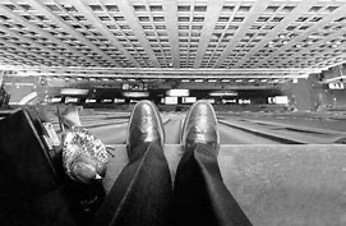
When we define ourselves by our sense-perceptions we are what we experience. So-called virtual reality experiences made by using images shown, for example, by a head-mounted display (HMD), like appearing to be standing alone in a snow-covered field or peering off the top ledge of a tall building, are real experiences (as defined by the dictionary). To accept the reality of these images, a person must ignore their thoughts and recent memories of being in a room full of fancy computer equipment and accept only what his or her sense-perceptions provide. Even if we might think or remember otherwise, the dictionary definition assures us that we remain in reality when our experience is accepted as valid—even if that tell us that we are looking down from a great height.

The greatest benefit to aligning with sense-perceptions and away from conceptual understanding is openness to the experience of the full range of living. Gender, for example, is often boxed in to two conceptual categories. Those two boxes do not to allow for the entire range of observed gender characteristics, some according to preference, some to anatomy, biochemistry, psychology, etc. An “open” world trivializes the rigidity of the categorical boxes that originate from language itself, including those that also support egoism, racism, genderism, nationalism, etc. A creative and flexible view, one in more accord with the full expression of life, becomes more available with this type of openness. Empathy—experiencing others for who they uniquely are—may increase. Insights, those unbidden flashes of wisdom that arise, may also appear more often when mental ruminations are not blocking its path. 

Language, the currency of the left brain’s conceptual processing, so pervades our life that we believe it describes reality. By definition, of course, language constructs a virtual reality. Virtual realities, including those nasty, over-arching ones of skepticism of what’s truthful, self-centeredness, phobias, etc., all originate here. Another harm from language is that it fails to specify anything as unique—like each of us individuals for example, or even any common object, like the lamp on my desk. The word “lamp” describes a large, general category of objects that produce light. Saying “It’s a lamp,” does not identify a specific one on my desk. The problem with lies in the fact that everything in the world is specific and unique. By accepting ourselves as a category (“soccer mom,” “hard worker”) we also lose our uniqueness our personal authenticity. Further, the individuality and uniqueness of others is similarly denigrated (like “young,” “multiracial,” “smart”). Come to think of it, everything loses its individuality because words cannot account for uniqueness.

Those who “buy in” to language take on lives lived as if they themselves are a category—like “depressed,” “important,” “football fan,” or “internet star.” This bargain involves losing one’s authentic self in exchange for becoming an artificial persona aligned to a category that seems beneficial. This deal with the devil requires the persona to dedicate himself or herself to the demands of the category and deny the openness that all lived-experience can offer. The rules of the category become paramount. Unfortunately, with the loss of one’s authentic humanity the persona’s their full capacity for empathy also diminishes. Rules come to matter more than people.

The practice of mindfulness is the process of paying attention to sensory-perceptual experience. It’s the only way I know of to return to reality. Initially, some find the practice of mindfulness difficult since virtual reality is so engrossing and actual reality so impossible to define by words. Many even allow thoughts to ruminate for hours in the hopes of understanding something new and important. But, research suggests that mind wandering causes more harm than good. Eventually, those who practice mindful attention can and do return to reality, accepting sensory-perceptual experience for the truth, and the oddities, it offers.

Though many think otherwise, the exit from virtual reality makes us happier and more content. Phobias lessen when fearful thoughts diminish and sense-perceptions dominate awareness. The pain that’s been in our shoulder will still exist but unnecessary worry will not. The felt sense remains with no bother at all. By making the shift from thoughts to experience, people get better. My own sense is this is how placebos work—by encouraging the release of thoughts and the return of one’s attention to their sense-perceptions. Granted, not everyone can make this mental shift but then again placebos only work in about one third of the people who take them.

There seems to be good reason to improve your relationship with reality—with your sense-perceptions: enhancing mental flexibility, increasing insightfulness, appreciating uniqueness, improving authenticity and empathy. There also seems to be good reason to decrease your reliance on the virtual world of thought-based reality—by minimizing the stereotypical thinking that maintains ego-centric greed, authoritarianism, antisocial behaviors, and the wide variety of forms of discrimination (racism, genderism). Becoming mindfully attentive takes a bit of practice. But there is little downside to losing virtual reality and a significant upside to increasing contact with reality.